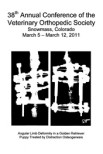
Clinical history An “Inlander” foal, 4-5 months of age, was presented with a history of angular limb deformity noted shortly after birth with bilateral valgus deformity that appeared to center on the knees - the deformity was more severe on the left and the owner thought the deformity was progressive Radiographs were made of the forelimbs with the x-ray beam centered on the carpus using a large cassette Dorsopalmar radiographs Lateral radiographsRadiographic changes - DP views On the DP projection, all changes are more evident on the left limb - the outward deviation of the metacarpus is evident with the pivotal point at the distal radial physis. On the left, the valgus deformity centers on the physis medially - a lucent zone at this site appears similar to a transverse fracture line - an increase in width of the physis is noted throughout. On the left, the subchrondal bone adjacent to the physis in both metaphysis and epiphysis lacks the expected density when compared with the right limb - this may reflect the deformity or a lesser weight bearing on the left limb. Radiographic changes - DP views The radial curvature is evident bilaterally more severe on the left, however an expected increase in thickness in the radial cortex laterally is not appreciated on either limb. Note the reactive spuring at the metaphysealepiphyseal junction medially more severe on the left. The size and shape of the distal epiphysis and carpal bones are unaffected. Radiographic changes - lateral views On the lateral views it was possible to detect minimal caudal flexural deformity with metaphysealepiphyseal spurring caudally - the positioning of the distal radial epiphysis was thought to be more caudally to a line drawn through the center of the limb than expected. Examination of the growth plate on the left shows a failure of the normal density seen within the bone surrounding the physis. Rotational deformity is not usually detected radiographically since it requires visualization of the feet to determine outward rotation (toe out) or inward rotation (toe in). Radiographic diagnosis Angular limb deformity of the left fore limb with valgus deformity centering on the distal radial physis with only slight flexural deformity. Changes primarily in the left limb. Differential diagnosis - the metaphyseal/ epiphyseal changes in this patient should not be confused with inflammatory or infectious physitis. Treatment (left limb) Periosteal transection and elevation (periosteal stripping) was performed on the concave side of the metaphysis. A temporary transphyseal bridging of the distal radial physis was accomplished by placement of a 4 hole plate medially. Post-operative study Comments Angular limb deformities can be angular, flexural, or rotational - in this patient the deformity appeared principally angular centered on the distal physis.
The pivot point can also be within the distal radial metaphysis, the physeal plate, the distal radial epiphysis, the distal row of carpal bones, or the carpometacarpal joint.
The limb distal to the pivot point in this patient is abaxial and the deviation is referred to as valgus. The most common deformity in foals is carpus valgus as seen in this foal. The use of a large cassette is necessary to obtain the opportunity to measure the degree of deformity and insure you have detected the pivot point.